
Why SA Shopify store owners are losing international sales at checkout (and how to fix it).
South African Shopify store owners are losing international customers at checkout not because of their products, but because of flat rates and surprise duties bills. Here’s exactly what’s happening and how to fix it.

Robyn Viljoen
You drove the traffic. They found the product. They added it to their cart. They got to checkout.
And then they left.
If you run a South African Shopify store that sells internationally, this is probably happening more than you realise. Not because your product wasn’t right, or because your price was too high.
It’s because your international checkout got in the way,
This article is about exactly what that looks like, why it happens, and what fixing it actually means for your store.
The flat rate problem
Most South African Shopify stores handling international shipping are doing some version of the same thing: a flat rate per destination, set up once, and never looked at again.
It looks something like this at checkout: a single option labelled “International Shipping R1000” with no carrier name, delivery estimate or alternatives.
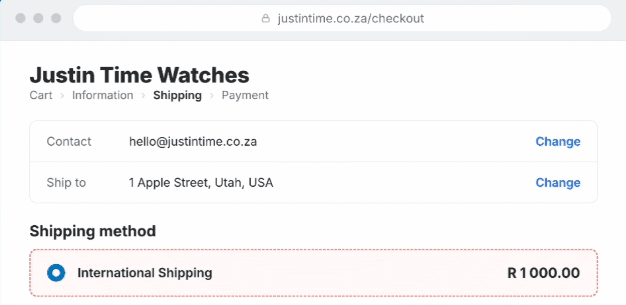
Your international customer sees this and has to make a decision with almost no information. They don’t know who’s delivering it, when it will arrive, or if the price is reasonable or outrageous for their destination.
A significant percentage of them leave.
48% of shoppers abandon their carts due to unexpected extra costs at checkout, making it the single leading cause of cart abandonment. For international shoppers, that risk is compounded. They face not just shipping costs, but potential duties and taxes they weren't warned about.
The flat rate isn’t just a bad customer experience. It’s a conversion problem sitting right at the bottom of your funnel.
The other side of the flat rate problem: your costs
Most store owners don't find out if their flat rate was right until the invoice lands.
For example, you set R1000 for international shipping to the UK. Maybe that covers your costs and maybe it doesn’t. That depends on the actual weight of the order, the dimensions, the service level, and the destination.
If you guessed too low, you’re subsidising every international shipment. If you guessed too high, you’re losing customers who see a rate that doesn’t feel worth it.
Live carrier-calculated shipping rates solve this completely.
Instead of a number you set and hope for the best, the rate is calculated in real time based on the actual order weight, destination, and carrier pricing at that moment. What the customer pays is what it costs.
What international customers actually need to see at checkout
Think about what a confident international checkout looks like from the customer’s perspective. They can’t walk into your store and can’t return something easily. They’re need to trust that the whole experience is going to work, and the checkout is where that trust either holds or breaks.
What builds trust at checkout:
Recognisable carrier names. FedEx and UPS are names an international customer knows. It signals that a real, established logistics company is handling their order.
Estimated delivery times. “7–10 working days” gives the customer something concrete. They can decide whether that works for them. Without it, they’re guessing, and uncertainty is a reason not to buy.
Multiple options. Economy or express, budget or speed. When your customer gets to choose, they own the decision. One option feels like a take-it-or-leave-it.
This is what the TUNL Shopify integration puts in your checkout. Live rates from FedEx, UPS and TUNL Economy displayed at checkout, calculated automatically on every order.
What this looks like when it’s fixed
Here’s the same purchase journey, with the checkout working properly. Your international customer gets to checkout. They see three shipping options:
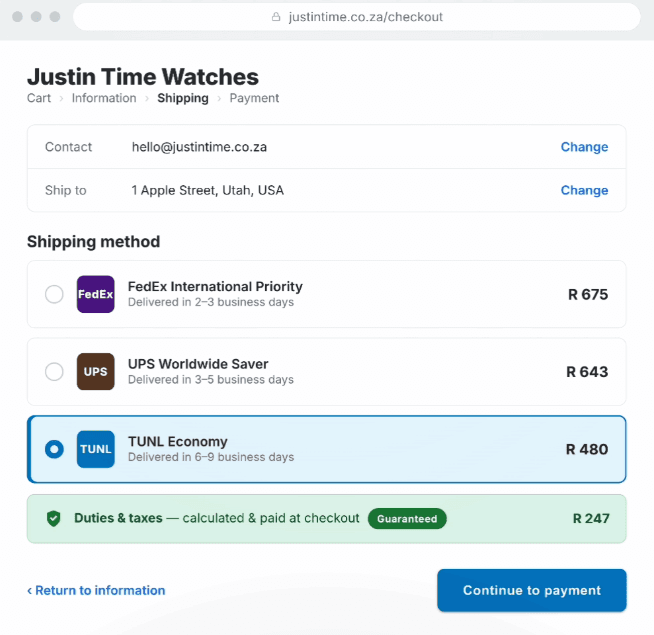
They know who’s delivering it, when it will arrive, and exactly what they’re paying (duties included). They pick an option that suits them and they check out. When the package arrives at their door, there’s no invoice waiting for them.
On your end, the rate is accurate. What they paid is what it costs and the duties are declared and covered.
This is what a properly configured TUNL Shopify integration delivers. The shift (from a flat rate and a duties surprise, to real options with full cost transparency) is one of the most impactful changes a South African Shopify business can make to their international conversion rate.
How to fix your international checkout
Install the TUNL Shopify integration. This connects your Shopify store to the TUNL platform, giving you access to live carrier-calculated rates from FedEx, UPS and TUNL Economy, plus duties and taxes at checkout.
Make sure your products have accurate weights. Live rates depend on knowing what the order weighs. Set accurate weights on your Shopify products (it’s a one-time task) so that rates calculate accurately.
Check your checkout. Once the integration is live, go through your checkout as if you were a customer in the UK or the US. The rates should be pulling correctly, carriers named, delivery estimates visible and duties included.
The setup is covered in detail in the TUNL Help Centre once you’ve installed the app. If you want the broader picture of how the whole integration works, The complete guide to setting up international shipping on your SA Shopify store covers it end to end.
The bottom line
Checkout is a common failure point for international sales. The moment when a customer who wanted to buy encounters a flat rate with no context, or a duties bill they didn’t expect, they often decide it’s not worth the risk.
Fixing the checkout is not a complicated project. It’s a specific infrastructure change that has a direct and measurable impact on your international conversion rate. The customers are there. The demand is there. The checkout is the thing standing between you and the sale.
→ Fix your international checkout. See how the TUNL Shopify integration works: unlocked.tunl.to
Explore more
Tools, tips and stories to help you take your business beyond borders.

How Veldskoen Built International Demand for a Proudly South African Brand
Learn how Veldskoen built genuine international demand for a South African brand. From smart Meta and Google Ads sequencing to email marketing and storytelling that turns local customers into global ones.

Michelle Etzebeth

Why SA Shopify store owners are losing international sales at checkout (and how to fix it).
South African Shopify store owners are losing international customers at checkout not because of their products, but because of flat rates and surprise duties bills. Here’s exactly what’s happening and how to fix it.
Robyn Viljoen

How to Calculate International Shipping Costs: Volumetric vs Actual Weight
Struggling with high shipping costs? Learn how volumetric weight vs actual weight affects your international shipping rates - and how to save money!

Robyn Viljoen

Ready to ship smarter?
Whatever you're shipping and wherever it's going, TUNL gives you the right option for every order. Ship from South Africa to 155 countries worldwide.
TUNL makes international shipping simple and affordable with an all-in-one platform, cost saving rates and seamless integrations - so South African businesses can ship smarter and grow faster.
Social Media