
Shipping Internationally from South Africa? A Quick Guide to Customs and Duties
Discover how to handle customs when exporting from South Africa. Learn about duties, taxes, and landed costs to ensure smooth international shipping for your business.

Robyn Viljoen

Key Considerations When Shipping Internationally
Taking your business global is incredibly exciting! But before your products reach their new homes, there’s one crucial thing to navigate – customs. Understanding duties, taxes, and regulations can be the difference between seamless global expansion and frustrating delays.
Let’s break it all down so you can avoid unexpected costs, ship with confidence and keep your customers happy.
Key takeaways in this article:
• Know your costs: Duties, VAT, and shipping fees impact your bottom line.
• DDP vs DAP: Paying duties upfront speeds up shipping and improves customer experience.
• Get your paperwork right: Avoid delays by ensuring accurate invoices and declarations.
• Understand landed costs: Display total costs upfront to prevent abandoned carts.
• Check restrictions: Every country has different import rules. Make sure you stay compliant.
Customs, Duties, and Landed Costs Explained
What Are Customs and Duties?
Generally, these are fees imposed by governments on imports to protect local industries and generate revenue.
The key costs to consider include:
• Customs Duties: A percentage-based tax on imported goods charged by the destination country, varying by product type and destination.
• Value-Added Tax (VAT) or Goods and Services Tax (GST): Additional local taxes applied by the receiving country.
• Carrier fees: The portion that the carrier charges you to get your package(s) through customs. This is sometimes called an advancement fee or disbursement fee.
• Landed Costs: The total cost of getting your goods to the customer, including all the costs above (shipping, duties, taxes, and carrier fees).
💡 Did you know? You can calculate landed costs upfront using TUNL’s platform during the shipping booking process. No surprises, just smooth sailing!
6 Tips for Handling Customs When Exporting from South Africa
1. Classify Your Products Correctly
Every product has a Harmonised System (HS) Code, which determines the duty rate in different countries. This is very specific to the product, for example, ‘men’s denim pants’ has a different HS code to ‘men’s cotton pants’. Getting this right prevents delays and incorrect charges.
✅ Pro Tip: Learn more about HS codes or use TUNL’s in-platform automated tools to find the correct HS code and estimated duty rates before you ship.
2. Choose Between DAP and DDP
One of the biggest decisions you’ll face as an exporter is whether to ship with Delivery At Place (DAP) or Delivery Duty Paid (DDP).
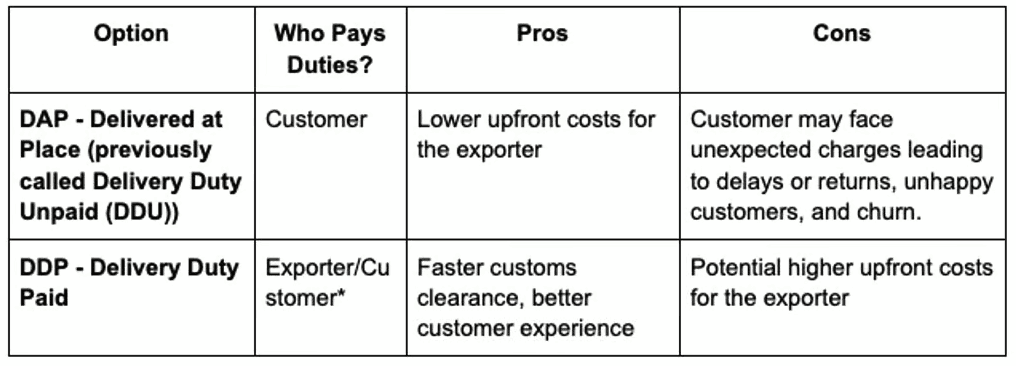
✅ Pro Tip: Opt for DDP whenever possible as it creates a more streamlined experience for your end customer, leading to more repeat business.
"We prefer to use DDP wherever possible. Even if it costs a bit extra for us, since it is usually much cheaper than what our customers will pay at customs" - Riyaadh Abrahams, co-founder of The Book Cove.
3. Understand Landed Costs Upfront
As mentioned above, we recommend shipping with DDP as it creates an all-round better experience. If you as the exporter are paying the duties and taxes costs, it’s helpful to understand exactly how much you’ll be paying so you can manage and optimise your margins. You can use TUNL’s built-in landed cost calculator to do this.
Additionally, if you book DDP with TUNL you get a guaranteed rate that will not change, so you know exactly what the cost is with no surprises down the line.
✅ Pro Tip: With TUNL, you can display landed costs at checkout on your website, enabling your end customer to pay for duties and taxes upfront. This further improves the overall experience as your customer knows exactly what they will pay at the beginning of the buying process. It also results in faster shipping because the duties and taxes are paid immediately, leading to faster customs clearance.
"Displaying landed costs at checkout has helped a lot. Customers choose DDP More often. It seems they do not mind paying extra at checkout to avoid the headache at customs" - Riyaadh Abrahams, co-founder of The Book Cove.
4. Get Your Documentation in Order
The number one cause of customs delays? Incorrect or incomplete paperwork. Make sure you include the following documents:
• Commercial Invoice (Including value, description, and HS code of goods)
• Export Declaration (Required by SARS for shipments above R50,000)
• Certificates of Origin (If claiming preferential duty rates under trade agreements)
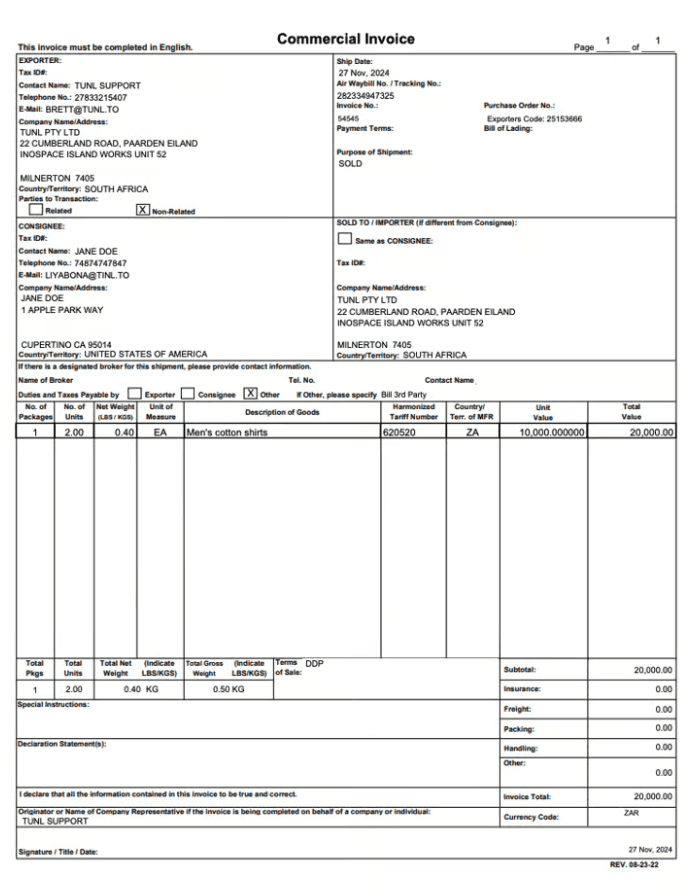
✅ Pro Tip: The commercial invoice is the most important document to get right. Here's a guide to filling it out correctly.
5. Take Advantage of De Minimis Values
Did you know that if you ship a package below a certain value to certain countries, you don’t pay any duties or taxes? For example, TUNL has sent more than 15 000 packages to the USA for our customers without any duties and taxes.
This is called the de minimis value. If your shipment's value is below the destination country's limit, it will clear customs faster and your customer won't get hit with surprise fees, making for a better experience all round.
✅ Pro Tip: De minimis values differ from country to country, and not all countries offer this benefit. The USA and Australia, for example, have generous de minimis thresholds, while other destinations may vary.
6. Understand Import Restrictions and Regulations
Every country has unique import restrictions. Some common restrictions include:
• Prohibited Items: Certain chemicals, perishables, and counterfeit goods.
• Restricted Items: Some electronics, food products, and medical equipment may require special permits.
✅ Pro Tip: Check destination country regulations before shipping to avoid hold-ups. If you’re using TUNL, our platform will automatically flag any prohibited or restricted items.
Ship Smarter with TUNL
Mastering customs and duties doesn’t have to be daunting. With the right tools and a bit of planning, you can turn cross-border shipping into your competitive advantage.
Ready to simplify your international shipping? Sign up with TUNL and we’ll help you navigate customs seamlessly and grow your global footprint in no time.
Explore more
Tools, tips and stories to help you take your business beyond borders.

How Veldskoen Built International Demand for a Proudly South African Brand
Learn how Veldskoen built genuine international demand for a South African brand. From smart Meta and Google Ads sequencing to email marketing and storytelling that turns local customers into global ones.

Michelle Etzebeth

Why SA Shopify store owners are losing international sales at checkout (and how to fix it).
South African Shopify store owners are losing international customers at checkout not because of their products, but because of flat rates and surprise duties bills. Here’s exactly what’s happening and how to fix it.

Robyn Viljoen

How to Calculate International Shipping Costs: Volumetric vs Actual Weight
Struggling with high shipping costs? Learn how volumetric weight vs actual weight affects your international shipping rates - and how to save money!

Robyn Viljoen

Ready to ship smarter?
Whatever you're shipping and wherever it's going, TUNL gives you the right option for every order. Ship from South Africa to 155 countries worldwide.
TUNL makes international shipping simple and affordable with an all-in-one platform, cost saving rates and seamless integrations - so South African businesses can ship smarter and grow faster.
Social Media