How to set up international shipping on your SA Shopify store
A practical guide for South African Shopify merchants on setting up international shipping: Carrier-calculated rates, duties at checkout and automated fulfilment, explained clearly.


South African products, from skincare to streetwear to handcrafted goods, are wanted all over the world. Shopify is an e-commerce platform that makes it easy to build an online store where you can showcase and sell your products internationally. But getting the shipping infrastructure right is a different story.
Most SA businesses selling on Shopify run into the same set of problems: checkout experiences that lose international customers before they buy, surprise duties bills that get packages refused at the door, and order fulfilment processes that eat hours every week.
These are avoidable. They're infrastructure problems, and they have practical solutions.
Setting up international shipping on your SA Shopify store is one of the highest-impact things you can do to grow your revenue beyond local borders. This guide walks you through what properly set-up international shipping looks like (from live rates at checkout to duties, carrier access, and fulfilment) so your store is ready for the customers you're trying to reach.
The problem with most SA Shopify international setups
Before getting into what good looks like, it's worth understanding what most stores are dealing with.
⚠️ The checkout is broken.
A customer in the UK gets to checkout on a South African Shopify store and sees one shipping option. No carrier name. No delivery estimate. No choice. They don't know if that covers their country, who's actually delivering it, or when it'll arrive.

Faced with uncertainty, a lot of them leave. Not because they didn't want the product, but because the checkout didn't give them enough information to trust the purchase.
⚠️ Duties are a surprise.
When duties and taxes aren't calculated at checkout the customer pays for the product and the shipping, the package travels across the world, and then a customs invoice arrives at their door weeks later. A significant percentage of international customers refuse the package when this happens. The merchant is out the sale, out the shipping costs, and left explaining to a frustrated customer why they got an unexpected bill.
⚠️ Fulfilment is manual.
Every international order means opening Shopify, copying the customer's address, switching platforms, pasting it in, going back for product details, booking the shipment, finding the tracking number, pasting it back into Shopify, marking the order as fulfilled, and notifying the customer. At low volumes it's painful. At scale it becomes genuinely unsustainable.
These aren't unusual problems. They're the norm for South African Shopify stores who haven't specifically addressed international shipping infrastructure. The good news is they're all solvable.
How the TUNL Shopify integration works
The TUNL Shopify integration was built specifically to address these problems for South African e-commerce stores. Rather than patching individual issues, it handles the full picture: the checkout experience, duties and taxes, carrier access, and fulfilment — all connected to your Shopify store. Here's what each of those looks like in practice.
Connecting the TUNL Shopify integration
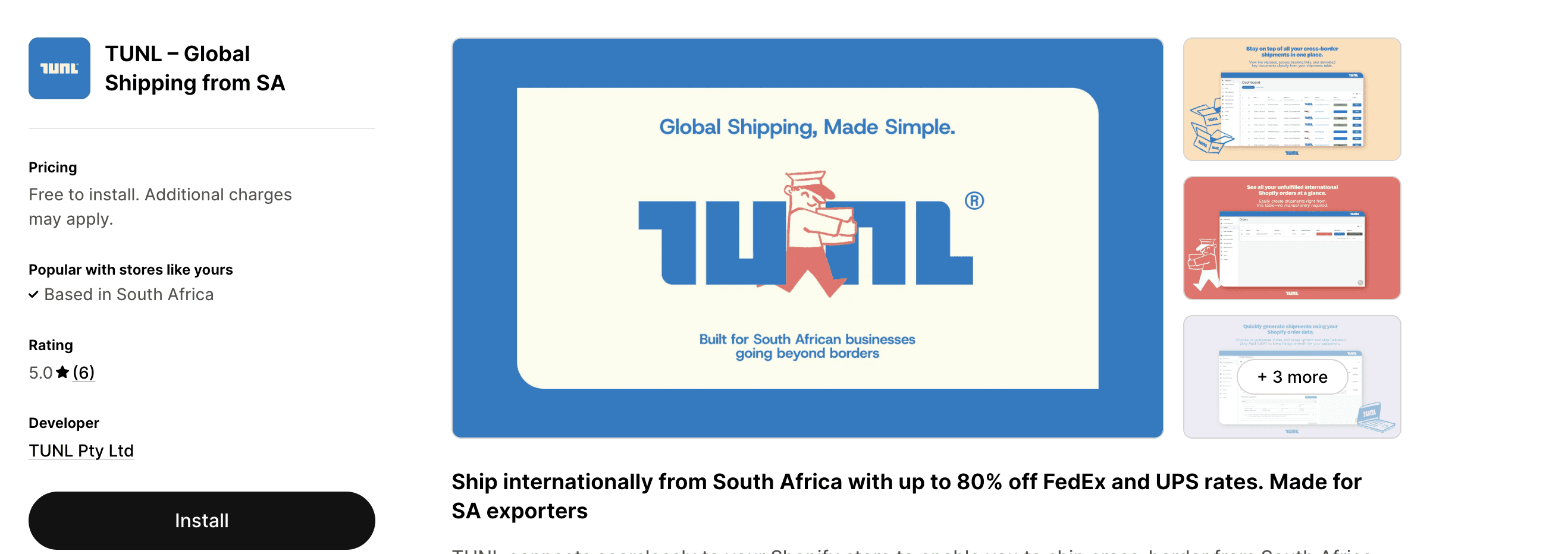
The TUNL Shopify integration is a free app available on the Shopify App Store. Installing it connects your Shopify store to the TUNL platform, giving you access to everything covered in this guide: carrier-calculated rates at checkout, duties calculation, automated order sync and one-click fulfilment.
Once connected, your Shopify store and your TUNL account are in sync. The features described below become available to configure on your store.
Setting up carrier-calculated shipping rates on Shopify in South Africa
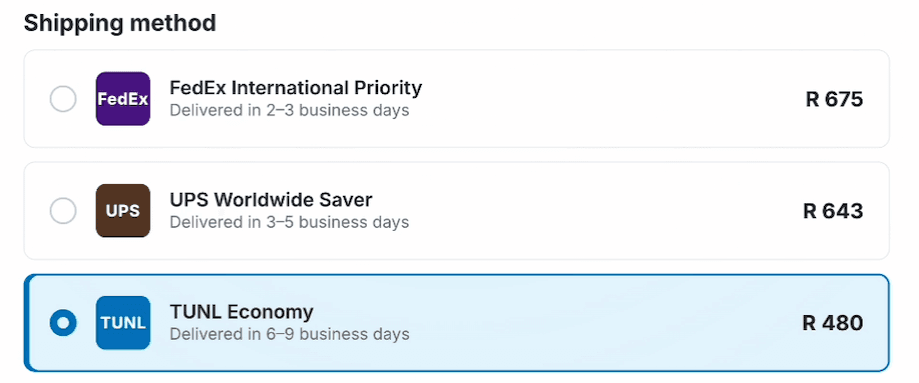
Instead of a flat rate, your international customers see real-time shipping options at checkout — pulled directly from FedEx, UPS, and TUNL Economy, calculated on the spot based on their order weight and destination.
💡What that means for your customer:
They see carrier names they recognise, accurate prices, and estimated delivery timeframes. Economy if they want to save money. Express if they need it quickly. They get to make an informed choice rather than take a leap of faith on a number with no context.
💡What that means for you:
The flat rate guessing game ends and you're no longer hoping your rate covers the actual shipment cost. The rate is calculated in real time and it's accurate. And because customers see multiple options, they're more likely to find one that suits them and complete the purchase.
Calculating duties and taxes at checkout
The TUNL integration calculates duties and taxes at checkout and displays them as part of the shipping options your customer sees. It works by mapping your products to the correct international product classifications and calculating applicable duties based on destination country.
💡What that means for your customer:
Your customer sees the full cost of their order (product, shipping, and any applicable import duties) before they pay. There's no additional customs invoice waiting for them when their order arrives. It means a purchasing experience that feels trustworthy and complete — the same standard they'd expect from an international brand.
💡What that means for you:
Because the amount is guaranteed and there are no surprises, less packages are refused. This results in fewer returns, fewer support queries, and customers who actually keep what they ordered.
Accessing international carriers at SA-specific rates
One of the practical challenges for South African brands shipping internationally is carrier access. Getting competitive rates from FedEx and UPS directly typically requires significant shipment volumes or existing commercial relationships. For most small to medium Shopify stores, that's not a realistic starting point.
TUNL gives SA businesses access to pre-negotiated rates from FedEx and UPS (up to 91% lower than direct rates), plus TUNL Economy as a more affordable option for non-urgent international shipments. This means your customers see competitive rates at checkout and your margins on international orders are protected.
You don't need a direct account with FedEx or UPS to access these rates. The integration handles it all for you.
Syncing orders and automating fulfilment
When an international order comes in through your Shopify store, the TUNL integration imports it automatically - customer details, delivery address, product information, and customs data included.
💡The fulfilment process is simple: you add the parcel dimensions (or select a default parcel you've saved), choose a service, and buy the label. One click fulfils the order and sends the tracking number back to Shopify, and automatically notifies your customer.
💡The customer experience is clean: they get a tracking notification promptly after ordering, and their expectations are set from the start.
💡Your experience is clean too: no copy-pasting, no tab-switching, no manual tracking updates.
For businesses who are currently doing this manually, the time saving per order is significant. For those who are planning to scale their international volume, it's the difference between fulfilment that grows with your business and one that becomes a bottleneck.
What you need to get started
1. A TUNL account:
You'll need a TUNL account in order to configure the TUNL Shopify integration. You can sign up for free or connect to your existing TUNL account.
2. Shopify plan:
Order sync and one-click fulfilment work across all Shopify plans, including Basic. Live rates at checkout and duties at checkout require the Shopify Grow annual plan.
3. Product weights and dimensions:
Carrier-calculated rates depend on Shopify knowing what it's quoting on. The rates are calculated based on the actual parcel weight and the destination, so your products need accurate weights set in Shopify. This is a one-time setup task that pays off every time a customer reaches checkout.
The bigger picture
Fixing your international shipping infrastructure isn't a marketing exercise. It's a conversion exercise. The businesses who do this well don't necessarily have better products or bigger audiences, they've simply removed the friction that was stopping international customers from completing their purchase.
These aren't features SA merchants have traditionally had easy access to. A checkout that shows real rates with real carriers. Duties handled upfront so there's no surprise at the door. A fulfilment process that doesn't eat your operational capacity. The TUNL Shopify integration makes them available without needing to cobble together multiple tools or negotiate directly with carriers.
If you're selling internationally on Shopify (or trying to) this is the infrastructure layer that makes it work properly.
Explore more
Tools, tips and stories to help you take your business beyond borders.

Why SA Shopify store owners are losing international sales at checkout (and how to fix it).
South African Shopify store owners are losing international customers at checkout not because of their products, but because of flat rates and surprise duties bills. Here’s exactly what’s happening and how to fix it.

Robyn Viljoen

How to Calculate International Shipping Costs: Volumetric vs Actual Weight
Struggling with high shipping costs? Learn how volumetric weight vs actual weight affects your international shipping rates - and how to save money!

Robyn Viljoen

How to Pack for International Shipping: 6 Smart Tips to Avoid Delays and Cut Costs
Packing smart means fewer customs delays and lower shipping costs. These 6 tips will help South African SMEs pack like pros and ship with confidence.
Robyn Viljoen

Ready to ship smarter?
Whatever you're shipping and wherever it's going, TUNL gives you the right option for every order. Ship from South Africa to 155 countries worldwide.
TUNL makes international shipping simple and affordable with an all-in-one platform, cost saving rates and seamless integrations - so South African businesses can ship smarter and grow faster.
Social Media