
Lessons from TUNL Talks: Optimising International Checkout for South African SMEs
Learn why international checkout conversion breaks for South African SMEs and how the checkout maturity ladder helps you fix what matters next.

Robyn Viljoen
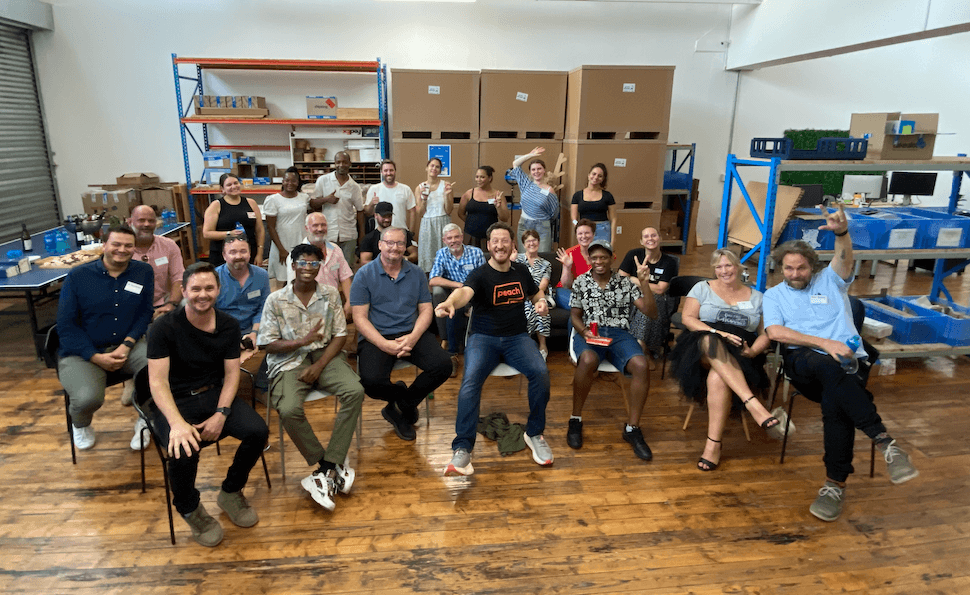
Global growth doesn’t fail because South African brands can’t sell. It fails because international checkout creates doubt for the end customer.
That was the central theme of last night’s ‘TUNL Talks: Optimise Your International Checkout’ event, where small businesses, TUNL and Peach Payments unpacked why international conversion drops, and what actually fixes it.
“Global checkout isn’t one big leap. It’s a series of many steps.”
Why international checkout conversion breaks
Most South African SMEs assume international customers drop off because of price. In reality, it’s usually uncertainty.
Uncertainty creeps in when key information only appears late in the journey. Shipping costs change at checkout. Duties are unclear or misunderstood. Prices are shown in one currency but charged in another.
Customers decide emotionally, not mathematically. And when checkout feels unpredictable, hesitation sets in. This is why optimising international checkout isn’t about clever tactics or one big fix. It’s about removing doubt, step by step.
Introducing The International Checkout Maturity Ladder
This is a useful framework that helps you to identify where you are today, understand what’s breaking conversion and see a clear next step.
“The goal isn’t to jump to the top. It’s simply to move up one level.”
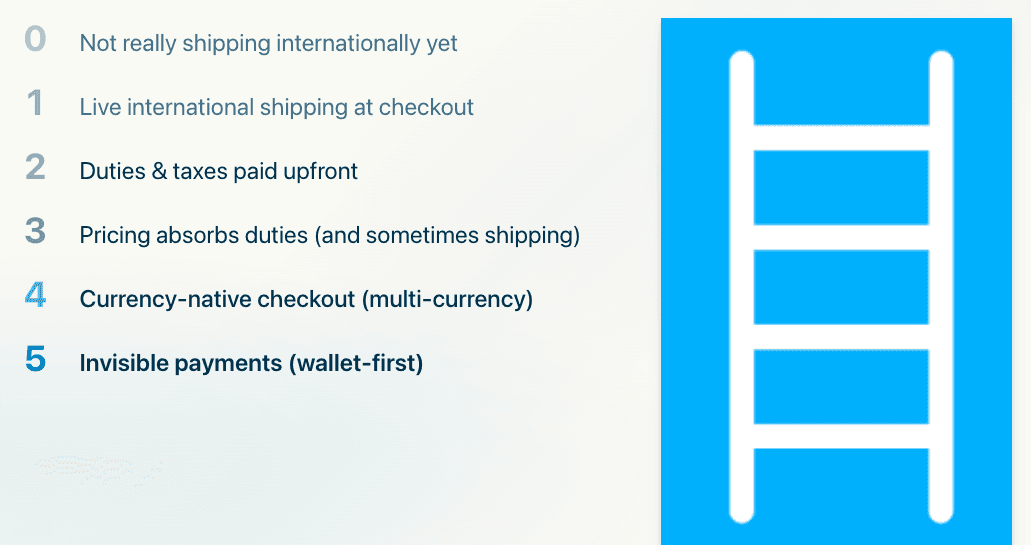
TUNL helps you move between Levels 1–3 (logistics, duties, pricing), while Peach Payments supports you in Levels 4–5 (currency and payments).
Level 1: Starting International Shipping from South Africa
At Level 1, businesses switch on international shipping and see their first overseas customers make it all the way to checkout. Addresses validate, shipping options appear, and orders start coming through. It’s an important milestone and the first real proof that international demand exists.
In practice, Level 1 usually looks like this:
Live international shipping rates appear at checkout
Prices are still shown in ZAR
Duties and taxes are not shown upfront
But this is also where new friction quietly enters. While shipping is now visible, the full cost still isn’t. Duties surface later, border calls and second invoices follow, and customers who felt ready to buy begin to hesitate.
International shipping is working, but international confidence hasn’t caught up yet.
💡Pro tip: You can show live international shipping rates at checkout on your eCommerce store with TUNL. Speak to our team to learn how.
Level 2: Showing Duties and Taxes Upfront at Checkout
At this stage, brands choose to remove uncertainty from the international buying experience. Instead of pushing complexity downstream, they surface the real total at checkout, and customers immediately feel the difference.
In practice, Level 2 usually looks like this:
Duties and taxes calculated at checkout
Customers pay everything upfront (DDP)
No surprise bills at delivery
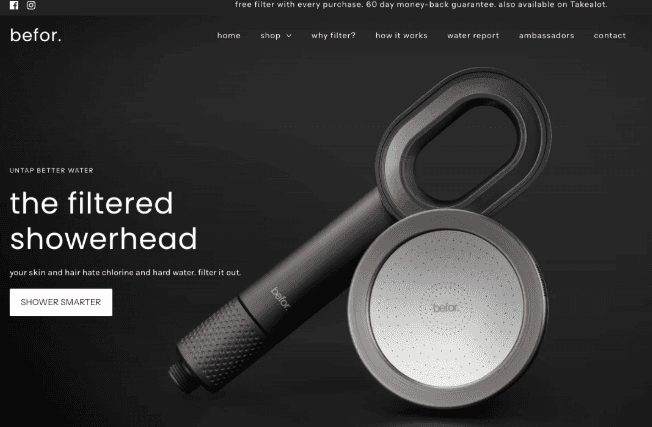
The impact is immediate. Customs confusions drop. Refused parcels become rare. Customers receive what they expected, at the price they agreed to.
This level solves two problems at once: the operational pain of failed deliveries and the trust pain that quietly kills repeat international purchases.
💡Pro tip: TUNL provides DDP shipping options and duties and taxes calculations at checkout, so the end customer knows exactly what they’re paying.
Level 3: Pricing International Orders for Predictable Checkout
Instead of asking customers to mentally add shipping and duties to the product price, businesses flip the model. The complexity still exists but it’s handled before the customer ever reaches checkout.
In practice, Level 3 usually looks like this:
Duties baked into the product price by market
Sometimes shipping absorbed too
One clean, predictable total
The emotional impact is immediate. Customers stop thinking about borders, customs, or calculations. What they see on the product page is what they expect to pay - and checkout simply confirms it.
For many South African SMEs, this is the first time international checkout feels genuinely comparable to local checkout. And it’s why Level 3 is so often the biggest single jump in international conversion.
💡Pro tip: At TUNL we like to call this ‘inclusive pricing’. Reach out to us and we can help you set it up!
Level 4: Multi-Currency Checkout for International Customers
By Level 4, logistics is no longer the main constraint.
Brands at this stage have already built trust around shipping and pricing. The remaining friction is currency. Customers may understand the product and delivery, but they still hesitate when prices and charges don’t match what they expect to see.
In practice, Level 4 usually looks like this:
Prices displayed in USD / EUR / GBP
Customers pay in their local currency
Card charges match what was shown at checkout
Even small currency mismatches can trigger doubt, declines, and chargebacks. Level 4 removes that final layer of mental conversion and makes checkout feel locally native for global customers, even when the business is based in South Africa.
💡Pro tip: Peach Payments’ multi-currency account enables you to remove currency conversion anxiety at checkout.
Level 5: Frictionless and Wallet-Based International Payments
At this stage, the checkout experience almost disappears. Returning customers move quickly. Mobile users don’t stall. Payment feels like a confirmation, not a decision.
In practice, Level 5 usually looks like this:
Apple Pay and Google Pay enabled
Minimal steps and interruptions
Mobile-first success
The reason this works so well is simple: wallets remove friction customers have learned to distrust. No OTP confusion. No unexpected declines. No second-guessing.
This level delivers the smoothest international checkout experience but it only works when the foundations beneath it are already solid.
What’s next for your international checkout?
The International Checkout Maturity Ladder isn’t about racing to the most advanced setup. It’s a guide to help you understand where you’re at and what you need to do to get to the next level.
If you’re a South African SME selling (or trying to sell) internationally, the most important question is
“What’s the next level for us and what’s breaking conversion today?”
If you want help figuring out where you sit on the maturity ladder (and how to level up without overcomplicating things) reach out to the TUNL team. We’ll help you focus on the step that actually moves the needle.
Explore more
Tools, tips and stories to help you take your business beyond borders.

How Veldskoen Built International Demand for a Proudly South African Brand
Learn how Veldskoen built genuine international demand for a South African brand. From smart Meta and Google Ads sequencing to email marketing and storytelling that turns local customers into global ones.

Michelle Etzebeth

Why SA Shopify store owners are losing international sales at checkout (and how to fix it).
South African Shopify store owners are losing international customers at checkout not because of their products, but because of flat rates and surprise duties bills. Here’s exactly what’s happening and how to fix it.

Robyn Viljoen

How to Calculate International Shipping Costs: Volumetric vs Actual Weight
Struggling with high shipping costs? Learn how volumetric weight vs actual weight affects your international shipping rates - and how to save money!

Robyn Viljoen

Ready to ship smarter?
Whatever you're shipping and wherever it's going, TUNL gives you the right option for every order. Ship from South Africa to 155 countries worldwide.
TUNL makes international shipping simple and affordable with an all-in-one platform, cost saving rates and seamless integrations - so South African businesses can ship smarter and grow faster.
Social Media